Central Research
SPATIAL DRAMATURGY
THEATRE THROUGH SPACE, MOVEMENT AND STRUCTURE
THEATRE THROUGH SPACE, MOVEMENT AND STRUCTURE
Spatial Dramaturgy is an ongoing research into how space, movement, structure and the relationships between them can become active elements of theatrical language.
It explores how a theatrical world can be composed not only through text or narrative, but through bodies, spatial relationships, rhythm, form, movement and collective imagination.
SPACE IS NOT A CONTAINER FOR THE ACTION. SPACE IS PART OF THE ACTION.

We often think of theatre as something that happens in a space.
Spatial Dramaturgy begins from another question:
What if space itself could participate in the dramaturgy?
A distance between two performers can create a relationship.
A structure can create tension.
A change of direction can change meaning.
An empty space can create expectation.
A pattern can organise movement.
A body can transform the perception of an entire space.
Spatial Dramaturgy investigates these relationships as compositional material.
SPACE
How space can become active, relational and dramaturgical.
MOVEMENT
How movement generates meaning, rhythm and structure.
STRUCTURE
How forces, forms and relationships organise theatrical composition.
TIME
How duration, rhythm and transformation affect perception.
BODY
How the performer inhabits, transforms and is transformed by space.
COLLECTIVE IMAGINATION
How performers and audiences construct a shared theatrical world.
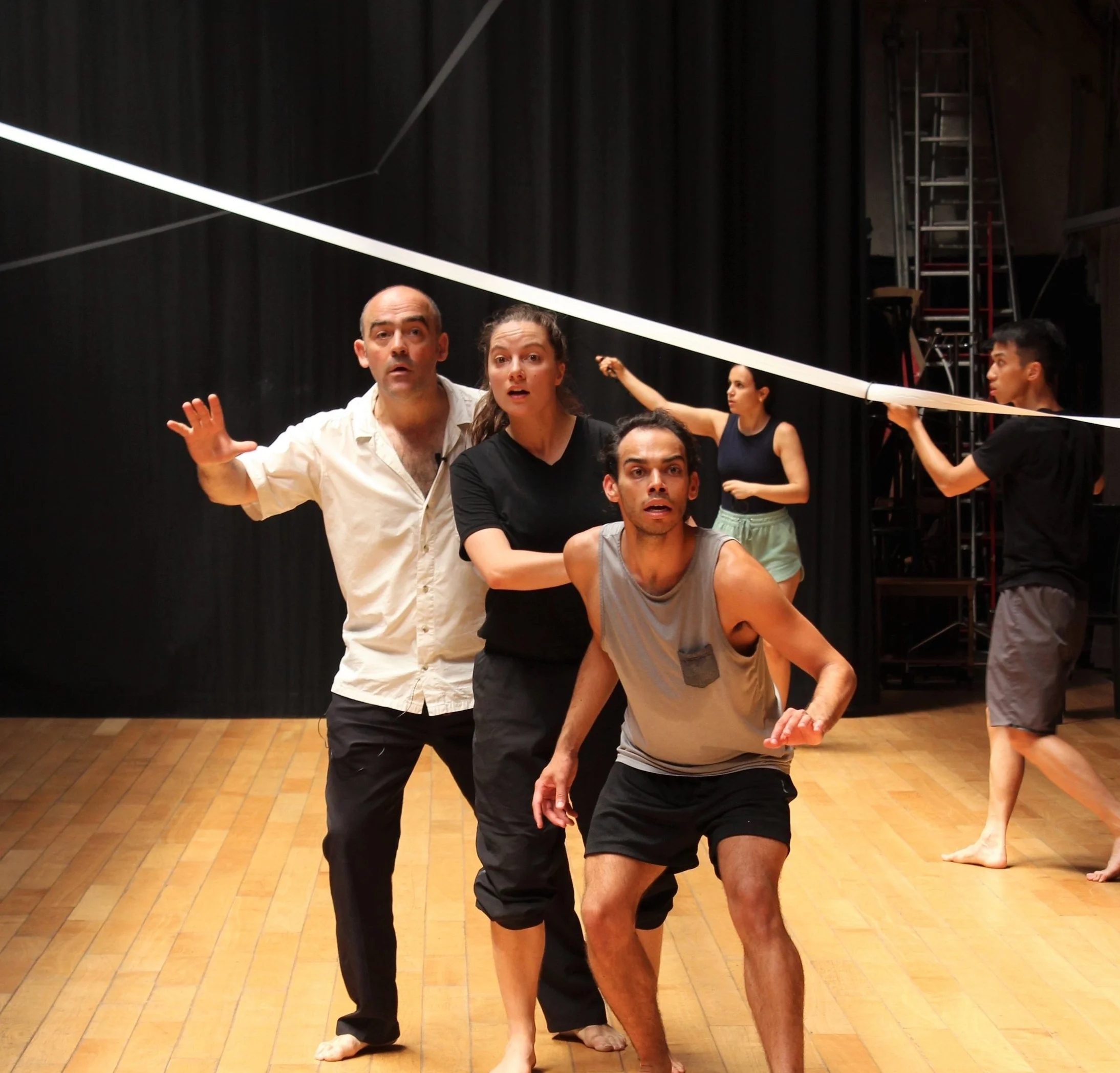
Spatial Dramaturgy has developed through a growing body of practical tools and concepts, including:
THE ELASTICS® — Ecosystem of Structures
Structures in movement and relationship.
INTERNAL SYSTEM OF FORCES
Exploring the forces that organise movement, form and theatrical presence.
TENSEGRITY FOR ARTISTIC CREATION
Using tension, compression and balance as principles for composition.
PATTERN LANGUAGE
Point, line, diagonal, circle and other spatial patterns as compositional elements.
CINEMATIC THEATRICAL LANGUAGE
Exploring framing, perspective, rhythm and spatial transitions within live performance.
In Spatial Dramaturgy, the performer does not simply move through space.
The performer creates space through movement, distance, direction, rhythm, weight, tension and relationship.
The body becomes both a performer and a compositional force.
Spatial Dramaturgy did not begin as a theory about space. It emerged from practice.
Carlos García Estévez began his research in 1998 through mask and Contemporary Commedia dell'Arte, following a provocation from Jacques Lecoq to search for tragic depth within comedy.
His encounter and later collaboration with Donato Sartori opened a deeper exploration of gesture, mask and the forces contained within form.
Over time, the question expanded:
This shift became an important turning point in the development of Spatial Dramaturgy.
In collaboration with performing artist and anthropologist Paige Allerton, the research continued to develop through spatial composition, structure, movement and collective imagination.
MASK, STRUCTURE, AND COLLECTIVE PRACTICE
In 2027, Routledge will publish a chapter by Carlos García Estévez examining Spatial Dramaturgy in relation to performer training, mask, structure and collective practice.
The chapter brings together aspects of a research process that has developed through years of practical investigation, teaching and artistic creation.
Forthcoming · 2027
Space is never neutral. The way we organise it changes what we perceive, how we relate and what we imagine.
Spatial Dramaturgy explores the possibility of creating theatrical spaces that remain open — spaces where different relationships, perspectives and realities can coexist.
A SPACE WHERE MANY WORLDS CAN EXIST.
Spatial Dramaturgy can be explored through:
PERFORMANCE
Developing theatrical compositions and productions.
TRAINING
Working with performers, directors and theatre makers.
RESEARCH LABORATORIES
Testing and developing new spatial tools and principles.
COLLABORATIVE CREATION
Applying spatial dramaturgy within specific artistic and cultural contexts.
See also Open Laboratories y TransPoetico
Spatial Dramaturgy remains an evolving field of research.
The questions continue to change as the work encounters new artists, places, bodies and forms.
What began through the mask continues to unfold through space.