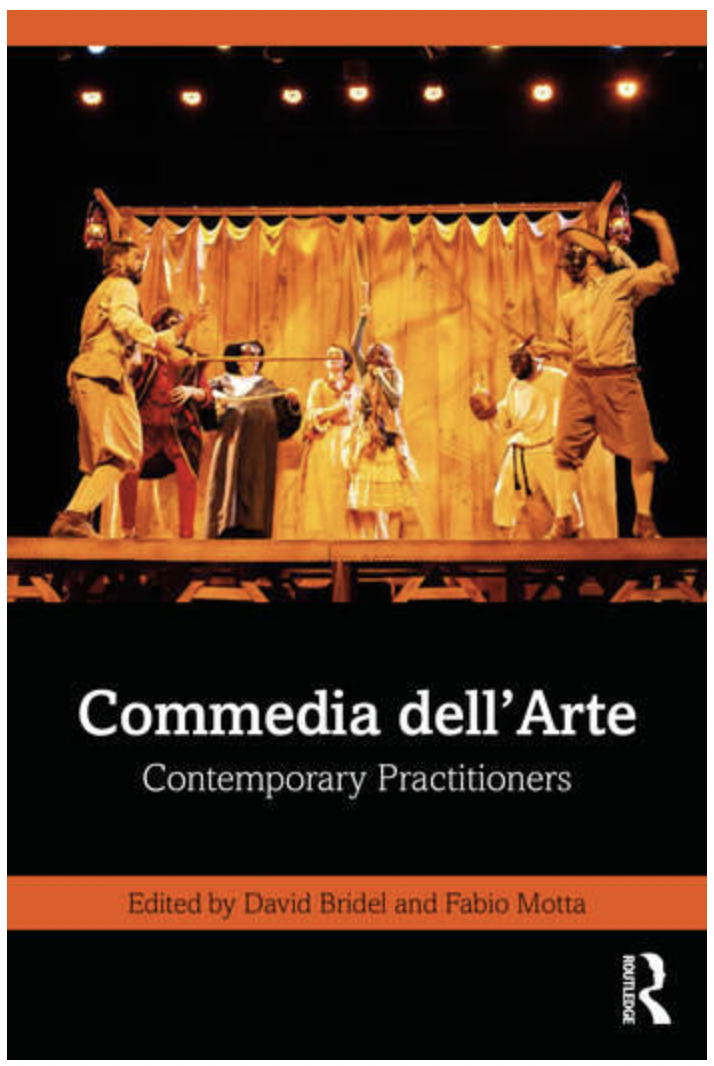
COMMEDIA DELL’ARTE - CONTEMPORARY PRACTITIONERS
Edited By David Bridel and Fabio Motta - Published April 1, 2026 by Routledge
Chapter 15
CARLOS GARCIA ESTEVEZ -
CONTEMPORARY COMMEDIA DELL’ARTE
Interviewed by David Bridel and Fabio Motta
Special thanks to editor Nicholas Phillips
PROVOCATIONS
The approach to commedia that was provoked in me by Lecoq prompted me to begin my research and, after a number of years, to go deeper, to a more fundamental level. The research has gone to the very abstraction of the form, mainly of the mask itself, as an object, as a structure. And this approach took me to new and different ways of creating theater. Through the commedia I could find many other styles: a clown could be there, tragedy, melodrama, and other new elements – more contemporary – the influence of different disciplines, filmmakers, musicians, philosophers, architects. So nowadays I create performances with communities, artistic communities, at festivals, with companies, in performing arts centers, all over the world. Commedia is something that I keep doing – as an actor and as a teacher, but also as a source of new artistic languages. My research starts from approaching the mask, as the mask contains the philosophy and the spirit of Commedia dell’Arte over time. (It persists over time, as when the actor dies, the mask lives on, becoming a fixed point in the tradition.) From there, I arrive at new things, new ways of doing things, always.
Technology is a powerful competitor to the theatre. I asked, why can’t the theater really reach the audience, like cinema is doing?
Why not? With the imagination of the actor, the artist, can’t we provoke in the audience a similar experience to the one they would have watching a movie? I have explored all these questions in the laboratory – little by little my research has given me tools to develop over the years. Nowadays, there is a theatrical language that I call Spatial Dramaturgy, which I developed with performing artist and anthropologist, Paige Allerton. As co-artistic directors of Manifesto Poetico, we explored how space itself can be a main element in the telling of a story. Of course, there are many other elements, but the main one is the space, not the actor, not the performer. This is more or less the arc of my work in general.
In my first 10, 15 years of work on commedia, contemporary commedia, I fell in love with the professionalism of the work. You could have singing, dancing, fighting, melodrama, comedy, the funny, the sad, and so on... I fell in love with that. When I was 20, I went to Paris to study with Jacques Lecoq, in my year there were nearly 30 different nationalities! Every week I was working, creating with people that – over the course of a whole year – I couldn’t understand; I couldn’t understand a word of what they said! I didn't speak French. The Japanese people didn’t speak French. The Americans didn’t speak French. Only the French spoke French! I thought: we just want to create, we don’t understand each other; but we do understand each other, not only between ourselves, but also in a dialogue with the audiences that we are reaching. This required us to discover ways of communicating with the whole body in space, that we wouldn’t have discovered, had we been able to use words. I fell in love with that. I’m passionate about it. Today, I ask myself and those I work with: how can we preserve the essence of humankind, regardless of culture, beyond cultures, beyond language, going through the passions and the emotions and all the common things that we have – love, respect, all these values and archetypes?
Over the years, this has evolved and developed into a more open body of research. I always say – it’s there in the manifesto – the laboratory has the mask as an object and the mask as a concept. The mask as a concept is what I’m exploring today. Commedia, as I understand it, is the mother of it. I believe the whole profession of theater today is based on this original comical art.
When I received the provocation from Lecoq, the first thing I did – suggested by Lecoq – was to go to Sartori’s mask centre. Donato Sartori (who was Amleto Sartori’s son), was my teacher and my master for many, many years. By now, I’m a friend of the family. I went there to understand the concept of the mask, how the mask arrived, the journey from sculpture to mask.
The very first time that I went to do Sartori’s mask-making workshop myself, I was a really bad maker; everything I did was bad. But I was fascinated by the process before the mask was completed. There is a huge amount of knowledge, practice, understanding, cultural understanding, before the making of the mask begins. And even after that, not every composition that is created does in fact work on stage. (Many compositions need to be made into masks, and tried on stage, to find one that actually works.) Like Donato used to say, I might make a hundred masks and only one is going to work. All of them are going to be beautiful objects, of course, but most are only good for the wall, as decorations. A mask that really is a piece of art for the stage and for the audience is very difficult to make. It takes your life to accomplish that. So for me, without knowing anything at the beginning – I was in my early 20’s – I wanted to know, what is behind the mask? That was the first question. Lecoq used to say that the abstraction of the neutral mask is found in the vertical and the horizontal. (It takes time to understand that – inside or behind the mask – we can imagine that there is an abstraction: the inner structure of the mask.) From there, it was really fascinating for me to explore the difference between the form and the structure. A mask is not only a form but a structure; it has a centre – a centre of gravity – of its own. From there, I started to see how I could work with the masks that I had.
THE HERE-AND-NOW
As you can imagine, I’m not approaching the famous stock characters. I'm not seeking to reproduce a stereotypical Arlecchino, or Pantalone. Yes, I’ve encountered teachers and masters that approach commedia in this stock way. I’m not interested in that because I think it’s dogmatic – and anyway, I don’t believe that we know how these characters were, exactly, in the tradition. I try instead to empty myself and see what this mask is telling me, how the mask moves. I always give the example of an instrument. For me, the mask is an instrument. And no two instruments are the same. They cannot make the same sound, even if they are similar. Even two masks that are the same, if one is a copy of the other, the pieces of leather that they are made from are not the same...
So each will give a different feeling. I perform a lot with a Tartaglia (a mask from the tradition who I named Lolo), a mask from Sartori, and I do have a copy of the same Tartaglia, also made by Sartori. And when I wear the copy, even the voice is different. It’s fascinating. So, I put myself at the service of the mask. I don’t put the mask at the service of my ego, my own ideas, my own understanding, my own knowledge. I prefer to start with the here-and-now, “I know nothing”, and let the mask talk. I’m not coming with an idea; I’m coming and trying to be in the here-and-now when I play with a mask. I am not going to impose a stock idea of Arlecchino onto 2024. I live in Madrid, and I don’t see people who resemble that kind of Arlecchino. I see other types of energies. I’m looking for how this mask, this object, behaves today. Can it hold and project the energies I see in people today? I’m open to discovering how the mask is going to behave. And then I ask: is it interesting? It’s important to see the action working.
Can the audience project onto the mask? I don’t play an archetype. This is another thing. I’m not playing an archetype. I’m not playing a mask of a commedia archetype. I play a character that provokes an archetypical behavior or reaction in the audience. If the mask works, it works all over. The whole audience is going to react.
THE SYSTEM OF FORCES
In the beginning, I always worked with masks from Sartori and another mask maker called Den Durand, who by now is an old friend of mine. I collected masks that really work for theater. And I started to goof around, to just play like a child, to see if I could understand the inner structure that drives these objects. Once I understood this inner structure, I could take away the mask itself, the leather object, and still inhabit, embody this inner structure in an abstraction. I encountered the system of forces, which is one of the main lessons I used to enjoy teaching at the Laboratoire d’Etude du Mouvement at L’Ecole Jacques Lecoq. There is a system of forces that is making this object move: to pull, to push, and even to compress the body in a particular way that makes the voice come out in the voice of the mask – not the voice that the actor wants to put on, because of their own interpretation. So my approach is always trying to look for the essence of the object, and understanding, of course, where that object comes from in its composition, its creation, and also the connection and the link with the cultural approach.
If I can see the abstraction of the mask, this structure, that has a center, that has a vertical, that has different lines that are projecting through space, then I am witnessing a system of forces. One line that goes down is going to have the contra-force or contra-movement from the core of the object to the opposite. Push and pull. To enter into this structure, I imagine that the center of this structure is going to be my center, my pelvis. And from there, I need to adjust myself to accommodate different forces moving in different directions. When I’m constrained inside this new system of forces, my body is not the same. The constriction in my belly or in my chest – depending on the particular mask – is going to change the circulation of the air and the compression in different parts of my body, which will give me a new voice, a new way to move. Once you get this, you understand that to put on a mask, you don’t have to do anything ingenious. The mask appears by itself. You are not having any idea behind it. You are just in the here-and-now. You are so busy adapting to these forces; you are trapped in that system of forces. These forces, which go in diagonals, in different horizontals – depending on the mask – are going to put me in a really difficult position physically: I must constantly adjust to keep my body in balance, inside of this new system, which is not my system. Timing becomes fundamental, the musicality of it, because otherwise it remains mechanical. In many trainings, laboratories, people who try to enter this world of the comedian, the world of the mask, they remain mechanical.
Now I, as an actor, Carlos, I have my own system of forces, but this new character has its own system of forces, and is going to breathe differently. To apply this new breathing without being blocked, without tension, we need to be released, we need to create a fluid way of moving these forces, something dynamic. We must move from the mechanic to the dynamic. These two elements are the first part of the technique, if you like. Then, once you are more familiar with this relationship between the mechanical and the dynamic – how to move, how to breathe with the mask – then the dramatic arrives. This is someone that is not me, this is someone new, that can behave in new ways, and tell the audience who he is, what he is doing, in the here-and-now. When I say “In the here-and-now”, I’m referring to timing. I always work inside the dramatic pulse. I feel the pulse "one, two, three" followed by the mask's action or reaction. I don’t let the actor think, because then it’s the ego, it’s an idea superimposed onto the mask. So rhythm is fundamental. And then, of course, from the dramatic, eventually, we can make people laugh or make people cry, both ways. And commedia has the potential to go even to the next level, which is the poetic. The suggestive thing, that thing where the audience leaves the show and a year later, they still remember, “Wow, it was in that balancing point, that was the moment where it caught me and touched me somewhere beyond my own understanding or rationalism”: this is the channel that the mask can create.
You cannot have tension without intention. If you continue pushing that intention in the line – in the horizontal line, the diagonal, or whichever line of force you use – madness arrives. Things get out of control. That’s what we are looking for. Take the famous jelly scene from the Servant of Two Masters, directed by Giorgio Strehler at the Teatro Piccolo of Milan, in which Arlecchino plays the legendary jelly lazzo. The actors must push the intention, within that circumstance, to survive. So the element of survival is always there. That’s why we call commedia the great game of extremes. Love and hate – you know – the extremes; nothing in-between (because that would be a luxury). The characters, the masks, are constantly in a survival state, like all of us! Tomorrow, we don’t know if we’re going to be here... This is a very instinctive and visceral way of working; it is animalesque; it is necessary. Alongside this, however, the actor also needs to contain this nature within the structure of the object. It’s the object that contains and proposes the directional forces of the character and performance; the performance is dependent on how the actor moves in space, how the actor uses the system of forces. And of course, the use of musicality. And the actor shouldn’t exploit the lazzi until the end. You don’t let the audience laugh until the end. You’re like a conductor of the orchestra. You don’t give it all away, you know?
You aim to master the container, which is your body, and you also need to feed the inner universe of the mask, which is the content. Not the story, but the universe, the life, what is behind you; who are you, where are you coming from? There are so many different elements that need to be inside of the mask. Form, direction, color, taste, sound: the actor has to inhabit all of these elements of the mask. We can talk about perspective, too. From the viewpoint of the audience, the mask exists within a perspective, a particular perspective. Some masks are frontal, while others operate best when the audience sees them from a three-quarters perspective. Of course, you can change the angle, but you really want a frontal mask to face the front to maintain’s its contact with the audience. A mask with a three-quarters perspective is most powerful when it projects into the audience at a three-quarters angle. When the actor turns ninety-degrees, you see the profile of the face, and the magic of the mask is lost. When the mask maintains its perspective, that allows the audience to remain in a constant and direct eye contact and connection with mask. This is very powerful. For me, with this contact, the mask remains alive. These are also the same relational principles that the actor, even without a mask, should apply. Of course, without a mask, eye contact with the audience shifts the work into a different convention and style.
When I’m putting on a mask, I remind myself not to think. No past, no future, just the here-and-now. This is the most difficult thing. And then the entrance – inside of that system of forces that I’m trying to describe – is also very important. When I’m really struggling – this is pulling, this is pushing, and I really cannot move – I’m breathing, of course – but I can't do whatever I want – I need to stay there. Stay in that condition. I’ve discovered over the years that this is when the audience becomes truly engaged. If I release this level of suspense, then somehow it gets a little bit blurry, for the audience that is.
When I was 25, I was another performer completely. Now, at my age, I am something else. I’ve evolved. I am not necessarily putting all the force, all the physicality, into my actions. Less is more. With time and experience, you understand that less is more. Nowadays I say it’s not me that’s moving, it’s the space that moves around me. I remember seeing Lecoq... We had a moment in the first year when we studied and analyzed animals. One day in class it was birds, all kinds of birds. We tried to do an eagle. One person, another person, trying, trying. And Lecoq was sitting in a chair and he said, “No, no, no: the eagle is this.” And then he just did a movement with his head. I promise you, I saw an eagle. He barely did anything, but I saw it. He provoked it in my imagination, and I made the whole image myself. I didn’t understand at the time, I just said, “Wow, yeah, he’s a master, and that’s an eagle.” No, he was not an eagle. It was me seeing the eagle.
THE CULTURAL APPROACH
If the mask works and only one person in the audience reacts, it is because what the mask is communicating has a certain cultural specificity; it is not universal. It may speak to some people in some cultures, but not to any person in any culture. I have to stay flexible in order to allow the mask to communicate to anybody.
On many occasions I’ve encountered different cultures, working all over the world, and what I’ve done in one place, when I’ve gone to another place, hasn’t always worked. The cultural approach is always at the service of the place where you go. It’s not about being super clever; it's that if I want to reach the audience (and for some of the original comedians, if they didn't reach their audience, they didn't eat that night), I need to create new things. This is in the spirit of commedia, the spirit of celebration, the spirit of being with and for the people, in service to them. If you go to Asia or South America, the people have different content in their background, in their families, in their histories, as countries, the geography, the weather. If you go to Norway, it’s another story. That's why I’m always at the service of the audience during the show, I have to ask, “Who are you? Who are we – now – in this context?” Also: you can see in Bali, for example, masks are very much based on colors and the symbolism of color. They are not necessarily masks for theater, but for ritual and ceremonies, all kinds of legends, tales, songs, beliefs, that are beyond theater. This is really seeing the mask from an anthropological angle, which is the very first thing that I encountered with Sartori, not to make the mask (because I lacked the skill to do so), but to understand that you need to go back, even before Commedia dell’Arte. Commedia, for me, is more interesting as a popular tradition, what it tells us about where we have come from as a society, as a culture, how the masks have been accompanying us.
But the mask is capable of going beyond culture. You know in your daily life when someone says something and you know it’s fake, but you don't know why. It’s your intuition, something that goes beyond cultural patterns and history and education and religion. The mask speaks to (and through) our intuition, to the deepest part of ourselves.
THE 60/40 PRINCIPLE
I rehearse 60% of the canovaccio. The other 40%, I do with and for the audience. The canovaccio gives the fixed points, the dramaturgy, the points that you must pass through, and you cannot change their order; that’s the red line, as they say. But how do you make the journey? That depends. It depends on how the audience is and how the audience reacts. You have an audience in the evenings with adults and professionals, and they go “Ha ha ha” very modestly, and then you perform a matinee, and you have students and then it’s non-stop crazy! You can’t play the same way to two different audiences! Also you cannot impose the story. You and the audience, you and the other characters: the story arises between you; you create it together – you cannot impose it.
So all the characters, all the actors, know what is needed to tell this story, but how you manage to capture the next point of the canovaccio is always by passing through the audience. That’s when the real improvisation appears. You fight, you struggle to keep telling this story, but the audience is more important. This push and pull between the audience and the story, these two things are in a communion. They need to be in communion. Why? So that the audience believes and feels that this is their story too: you do it with and for them. Maybe a scene that is usually five minutes, tomorrow is going to be eight minutes. Because of an extraordinary moment with the audience. A few months ago, I was in Cuba, in Havana, performing in a black box theater, maybe 150 people in the audience, a small venue. And right in front of me, in the audience, there was a very exciting person who could have been a character in the exact story I was presenting. Later in the show, my character was supposed to declare his love to a person just like that. I saw that person in the audience in front of me and I fell in love with them. Obviously, it was my character who fell in love, because I was in the here-and-now, and this was a really beautiful person. I asked them if they would come on the stage, and I made my character’s love declaration to them. This was a real improvisation – not because I wanted to improvise, no, no, my job was to finish the show, finish the canovaccio – but I was in the here-and-now, and it happened! Let’s take that risk. Let's enjoy this 40%, the unknown, right? I asked them to give me a kiss and they did. It was a fantastic moment!
You need to be really rigorous and not let this 40% be lost. If you don’t go on the adventure that the mask requires, the improvisational aspect of it, the madness, you stay in the 60%. The show is there, it’s safe. But you have missed your chance to provoke the audience. When you’re truly present in the here-and-now, an event can arise between the actor and the audience. The phenomena, the mask looking at an audience, for real, into the eyes of the audience. When I look into the audience, I am really doing it, and a provocation, a reaction in the audience will appear. Sometimes it’s big, sometimes it’s not that big, but it’s in the here-and-now. Direct contact with the audience brings laughter, or a reaction, and then I take it immediately and I send it back. It’s a circulation. The masked performer is in a game with the audience.
Here’s the theme of a fun improvisation. You arrive in a space. There is a letter on the table that you didn’t know was there. You discover the letter, open and read the letter, and you can go in one of two ways. Either it’s very good news or it’s really bad news. But it can take you one hour before you open that letter, experiencing the push and pull, caught in the system of forces. Why don’t you open the letter? Because you are with the audience. The audience wants you to open the letter, you want to open the letter, there is an urgency, a state of survival. But because everybody is alive, there are counterforces – different directions – and this combination and this phenomena is what makes the audience not want you to read the letter, not want you to sit down on the chair, not want you to give the kiss.
Once you give the kiss, it’s over! So how much are you in this game, in this system of forces, push and pull? For me, this is improvisation. This is the condition of the mask. And of course the fixed point. We need the fixed point, the look of the mask to the audience, the connection of the eyes, the timing. Why? Because this moment of pause, a fundamental component of music, this moment of silence, is what the audience needs to reflect, to receive and to follow the mask. It’s fundamental.
As I said, before theater, before the commedia, the mask was used to connect us with this other, with the unknown. In Commedia dell’Arte the mask was brought down into the horizontal, the people, onto the ground, into the problems of money, love, war. But I’m equally interested in the transcendental aspect of the mask, the relationship between actor, mask, and space, and what happens in between these things. Space is not just a question of distance. There are things happening, on the level of the collective consciousness, you know? When I perform in a mask, sometimes I look at the audience and the reaction of the people is just... They are taken by something. It is not that they are looking at something; it is that they are taken by something. There is a way of using the energy with a mask to create such a clean channel, to address and to reach and to grab the audience, that makes a shift, or should make a shift. I’m interested in this element, in this aspect of the mask. Of course the mask projects, in a very physical, mechanical way, but in their inner imagination: the audience is the one finishing the story, putting the dots together. This is my approach and what I believe.
TEXT
The text is another layer, another layer that you must accomplish. And it has its own musicality. You have to treat Moliere or Shakespeare with respect. You change this ratio of 60/40. If you don’t do that, you just misuse the expertise and the glory of Shakespeare or Lope de Vega or Cervantes. So it is different – not a different approach, but different amounts. You are less free. I remember in France, years ago in Paris, I watched Mario Gonzalez. He was directing a Moliere, I think it was Tartuffe. The actors were very well trained. I was really impressed. The text was there, but they were juggling the intentions. It was very good. The investment in the text needs to be big, intense. It’s a great challenge. Now, I don’t have anything against written texts, plays, but personally, my career took me in a different direction, not to use a written text.
COMMEDIA TODAY
Professional actors, artists, we need to honor the fact that because of commedia, we can be professionals. We can do what we are doing today. But Commedia dell’Arte, the meaning of the term nowadays: it is a business construction. The roots of this type of theatre were in the popular tradition of how people celebrated life in the villages and towns, and later in the professional companies of players with their repertoire. But the term has become commodified, turned into a workshop business construction, in order to sell courses, sell masks. If you go into the street, into the villages, into the university, will you see someone like those characters who are being portrayed on stage? Do you recognise among the people the characters that you see in the theatre? Because if we cannot recognise it today, it is not drawn from life; it is something else. The pedagogy of Lecoq is based on the observation of life. This is the main element. From there, we transpose into other ways of seeing reality. But we need a relation with reality. Abstraction, transposition can follow, but always based in what is in the here-and-now. Commedia, I think, needs to go into this direction today. We need performers that touch the audience in a way that makes the audience question their existence today. The more we stay in the idea of what we thought Commedia dell’Arte was, the less we push forward; instead, we need to move forward, to evolve as a society. The real definition of tradition? Tradition evolves. Bull fighting in Spain – don’t call it tradition, because it hasn’t evolved. Today, it doesn’t make sense at all. It’s folkloric. And it’s not interesting, because if you do folklore, you end up with something sterile, dogmatic. (The culture of bull- fighting: I hate it!) It is better to not know anything and see what we have. To be able to create a point in space where everybody can converge, the audience can converge and see themselves in that unique point. For me, that is the archetypical reaction, the catharsis that we are aiming for.
If there is not a tragic depth inside the commedia then commedia cannot exist. To live in a constant tragic dimension, this is the essence of the commedia. Charlie Chaplin’s character is not trying to be funny. We laugh, but he’s constantly in a tragic dimension himself. It’s important to me as an artist – if I take out a mask and perform, people should cry. That’s something that I always say to myself. Lecoq taught me, we live in a tragedy, it’s tragic! The way the characters pass through the story, the canovaccio, trapped in their own stupidity, that’s what makes people laugh. We watch someone fall on the street and we laugh. He nearly died! We go to a funeral and we cry with laughter. Tragedy and comedy. But at the base, it’s tragedy. The more tragic you are, the more the audience laughs. You don’t want “Ha, ha, ha.” That’s not a laugh. You want a laugh that comes from the gut. I laugh because I don’t want to cry. That’s what I'm interested in. Touching the inside of the audience. Not the cultural patterns that the audience brings into the theater, you don't want that. Lots of people do really well provoking at this level, but the mask... I think the mask touches the place that is transcendental. I don’t mean holy or ceremonial, no. But transcendental, like the way music takes you. The mask is the same.
Commedia, that was once a living artistic tradition, has become very superficial. Since the 1980s, it’s become a workshop business. It’s too easy to “learn the characters” and do a funny voice, to do something ordinary and badly made. We see a lot of entertainment: people spitting fire and juggling and doing funny things. But for me that is a misunderstanding and a misconception and misinterpretation of commedia, of what it was, of what it can be. We are in a time of narcissism, of course; the era of me, me, me. But if you, the actor, are not capable of emptying yourself, deleting yourself and putting yourself in service of this form, then the audience is not going to be touched by what you do. They may be entertained, but – based on my international experience in the last thirty years – they are not going to be deeply moved.
This is why mask training, training to put the whole actor at the service of the mask, is so important for the young actor. Young people come to acting with so much confusion, from TV, from the movies, from social media; their heads are full of ideas of what performance means. But they don’t understand that acting, performance, is an art. To make people dream, that's art. Everything else is just entertainment.
We are competing with technology. Technology is always going to be the option for an audience these days. We’re up against big monsters, technology, capitalism. But if a mask (of any form) works, truly, the audience won’t want anything else. The mask catches, traps something that is inside us, that comes from generations back, something that is calling us from beyond this (our) lifetime, something that we recognize but we can’t know where or when it is from, something in our DNA. If the mask works at that level, then forget about technology (I would say). The mask is the great game of sincerity, the great game of honesty.
What I say to artists that I work with, and what I believe: if you don’t have anything to say, don’t call yourself an artist. Call yourself an entertainer; but if you don’t understand the three parts of the interaction – between the creator, who is an artist, the audience, and the story – if you don’t understand why or what is happening, then why are you doing it? Many people put on a mask, change their body or transform, and they call that theater. But for me it’s not theatre; at least, it’s not art. A performer must enter the inner world of the audience and understand it. As an artist, I must know why I’m here, not just for myself, but because when I look at my fellow audience member, I say, “Yes, wow, the world could be better.” As artists and audience, together, we dream and we imagine a better world: unity, equality. The mask is the creator of that dream, the first piece in the domino effect. It has been, always, in all cultures before theater even appeared. There was a time when it came from shamans. The shaman dies, but the mask continues.
If I look back to the beginning, my conversations with Sartori: there are many, many, many elements that go into the composition of the mask before the physical mask appears. Balance, forces, breath, space, proportions, duration, weight. The mask is not the main thing. Those elements are the main thing. A couple of years ago, I proposed an open laboratory. I opened the laboratory with the idea of the mask dimension. Not the idea of the commedia but the dimension of the mask. What is that dimension that we need? How can we become extraordinary? The extraordinary is where the mask needs to be. As an actor, if I am not engaged on an extraordinary level, I cannot be of service to the mask.
What interests me is the actor, the audience, the people: that’s enough to celebrate the spirit that we all share. To be together; to survive. Survival is not that obvious nowadays.